Showing posts with label Nativism. Show all posts

Tuesday, September 1, 2015

The Enduring Power of Nativism


Nativist rhetoric in the United States, culled from a
vocabulary of hatred, fear, intimidation, and exclusion, reverberates in weird echoes across the centuries.

“We do not accept Jews, because they reject Christ!” the fictionalized character Clayton Townley ranted in Alan Parker’s 1988 film Mississippi Burning. “We do not accept Papists, because they bow to a Roman dictator! We do not accept Turks, Mongrels, Tartars, Orientals nor Negroes because we are here to protect Anglo-Saxon democracy and the American way!”

Parker’s film dramatized the deaths of the three Civil Rights workers killed in Neshoba County, Mississippi, on the night of June 21, 1964. The bodies of James Chaney, Andrew Goodman, and Michael Schwerner remained undiscovered until early August 1964. Their efforts to register African Americans as voters during “Freedom Summer” led to their murders.

Eighty-seven years before to the day, on June 21, 1877, the Commonwealth of Pennsylvania hanged the first eleven of an eventual twenty-one Irish Catholic men for alleged “Molly Maguire” crimes. Ancient Order of Hibernians (AOH) officer Patrick Hester died on the gallows in March 1878.

Before his arrest Hester, a grandfather and former school director, township supervisor, tax collector, and overseer of the poor, had worked for the naturalization and enfranchisement of Irish Catholic mineworkers. An editor, horrified at Hester’s efforts toward suffrage at the local courthouse, described Hester as “one of the acknowledged leaders of what is called the Democratic party in the Coal region, who with a number of his countrymen … just arrived from the temple of Justice, where they had been invested with the rights of citizenship …”

The editor warned: “Let native and Protestant American citizens ponder before they surrender their dearest rights to the rule of the Pope, or to the aggressions of the agents of foreign potentates.”

In Mississippi in 1964, the White Knights of the Ku Klux Klan drove the murders of Civil Rights workers. During the “Molly” trials in the mid-1870s, nativist lodges honeycombed Pennsylvania’s hard coal region. They went under cover of patriotic-sounding names.

A few weeks after the June 21 executions, a correspondent from Mahanoy City, a heavily Irish area, wrote to the Boston Pilot: “… we have got the ‘Junior Sons of America,’ ‘Mechanics,’ and many other secret societies, calling themselves Young Americans. The ‘Junior’ boys tell their fathers that they have not the same right here as [their sons] have, because they were not born in this country.”

Two Pinkerton agents who drove the “Molly” caseload, James McParlan and Robert Linden, took up residence in towns that housed prominent nativist factions. McParlan lodged in Shenandoah, home to Washington Camp No. 112 of the Patriotic Order Sons of America. The year after McParlan entered the region, Shenandoah formed a secret society under this disturbing name: “Sons of America, Shenandoah Commandery No. 14, Master Americans.”

Linden, McParlan’s supervisor, lodged in Ashland, home to Ashland Camp No. 84 of the Patriotic Order Sons of America. The Ashland division housed a subdivision with another troubling name: the “White Degree council.” The possible influence of McParlan and Linden with these groups has never been investigated.

At the issuance of the “Molly” death warrants in May 1877, the Shenandoah Herald published a column under the jocular heading “Girardville Giblets.” It carried a bald nativist taunt: “All our peace and order loving citizens were made happy this evening on the appearance of the Herald, containing the information that a beginning was to be made at disposing of the ‘Mollie’ murderers. All were happy to know that Governor Hartranft had determined to enforce the law, and that in the future, as at the present, ‘Mollieism’ has got to take a back seat, while white men say what shall be done.”

A half-decade before, the editor who so feared the enfranchisement of regional Irish Catholics had urged: “Every opponent of the Irish supremacy in this county should make it a point to examine the list and see if he is registered. … If the full vote is brought out the result will be a complete overthrow of that faction which is attempting to bind our county hand and foot to the Irish power.”

Within eight years of that publication, nativist rhetoric had helped destroy the power of “that faction.” The AOH in Pennsylvania’s hard coal region was broken. Its leaders had died on gallows in five counties, sat serving long prison sentences, or had long since fled the region.

To further explore the history of Pennsylvania’s Hibernians prosecuted as “Molly Maguires,” visit www.kehoefoundation.org.

Thursday, September 15, 2011

The Politics of Schuylkill's "Molly Maguires": Part 2 of 2

Thomas Nast Enters Their Arena
Bernard Dolan’s October 1875 letter to a Pottsville editor does in one stroke what no historian has ever done for Pennsylvania’s “Molly Maguire” recording. This former Ancient Order of Hibernian (AOH) delegate for Schuylkill County described Schuylkill’s AOH men not as members of the “poor laboring class,” but as voters who chose those politicians most likely to “assuage the sufferings of … their brothers in toil.”*

Dolan’s letter highlights the truth of the AOH officers of Pennsylvania’s hard coal region. Some AOH members executed as “Molly Maguires” were mineworkers. But AOH leaders executed as “Mollies” were not. These Irishmen had worked their way out of the mines and into ownership of hotels and taverns. They were no longer members of “the poor laboring class,” no longer “hewers of wood and drawers of water.”

They were, in fact, area businessmen. The 1870 U.S. Census lists AOH delegate Dolan, born in Massachusetts, as a hotel keeper. It lists Dolan’s declared value—real estate and personal—at $6400.

As a former AOH county delegate, Dolan had immediate knowledge of the voting habits of AOH men. But no historian has ever documented Dolan’s take on AOH political reform. Only Dartmouth historian Wayne G. Broehl Jr., writing in 1964, has mentioned Dolan’s letter—and then only with condescension. Broehl called Dolan’s effort “a particularly arrogant letter.”

Eighty-nine years after its publication, Broehl dismissed Dolan’s impassioned defense of his fellow AOH men as “particularly arrogant.” Vital clues into the "Molly Maguire" story have remained buried in this letter for more than a century. Dolan’s description of AOH electoral activity gives the seeds of the political contention that drove the onslaught against both Pennsylvania’s alleged “Molly Maguires”—and against the AOH order generally.

+++++++++++++++++++++++++++++++++++++++++

That onslaught relied heavily on the work of artists and editors.

In August 1871 the Irish Times correspondent who spoke of Irish Americans as “hewers of wood and drawers of water” warned his countrymen: “The mass of the Irish who come here to earn their bread find very little favour [sic] from the Yankees.”

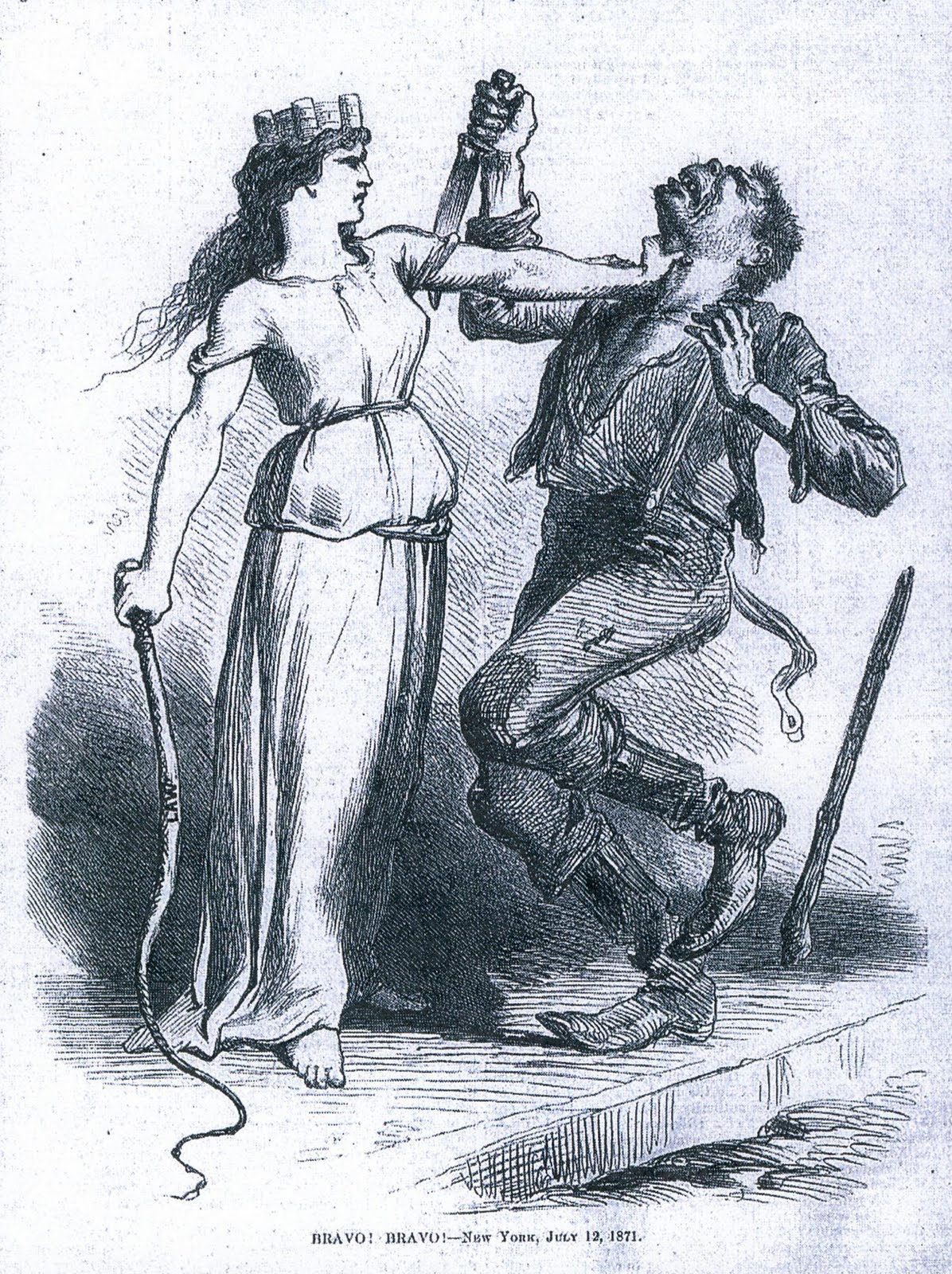
One month previously, after a bloody clash in New York between parade watchers and militia during that city’s Orange Parade, Thomas Nast penned one of his most outrageous cartoons. Nast’s cartoon did nothing to help the Irish find favor with the Yankees.

Like Allan Pinkerton’s artists, Nast made no secret of his contempt for Irish Catholics—or his willingness to lend his pen to inflame campaigns of ethnic hostility. Nast’s July 1871 cartoon showed an Irish ape dressed in patched workingmen’s clothes. As in the best Irish caricatures, Nast’s beast wears boots with upturned toes. The beast’s suspender strap drops and curves down like a devil’s tail. His upraised arm wields a knife, poised to plunge it into Lady Liberty’s breast.

If nativists commissioned Nast’s effort, they got good value for their money.

Harper’s Weekly published Nast’s cartoon. Its brutish Irish ape carried not just the power to shock. It carried the power to distort, to inflame and to mobilize resistance against any number of perceived Irish threats. It carried the power to lodge itself well in the public consciousness.

The publication in New York in July 1871 of Nast’s Irish beast attacking the icon of American liberty came just four months after the AOH order legally filed identical state charters in both New York and Pennsylvania. And as Bernard Dolan eloquently stated in 1875, the AOH order sent its Irish Americans voters to the polls to vote thoughtfully—in the interest of both their states’ welfare and workingmen’s issues.

+++++++++++++++++++++++++++++++++++++++++

In mid-winter 1875 an unknown someone also hired Nast to make the long trip from New York to Pennsylvania's Schuylkill County. During Pennsylvania's "Long Strike" of hard coal mineworkers, a Shenandoah newspaper used Nast’s cartoons to jeer at area Irishmen in the hard coal region. The Harper’s Weekly cartoonist trained his pen on an Irish union delegate subsequently arrested as a “Molly Maguire.” The Irish union delegate emerged in Nast’s cartoon as a drunken, poorly dressed, overweight leprechaun.


Someone hired Nast to train his vitriol on Irishmen in not one, but two volatile political arenas: in New York, and in Pennsylvania’s hard coal region. In both arenas, the AOH order figured prominently. New York got an Irish beast attacking Lady Liberty. Pennsylvania got a union delegate portrayed as a dissipated leprechaun.

Who encouraged—who purchased—Nast’s coverage?

+++++++++++++++++++++++++++++++++++++++++

Eleven months after the appearance of Nast’s cartoon ridiculing Schuylkill’s union delegate—and just two months after Dolan’s declared manifesto that Schuylkill’s AOH men voted only for candidates “whose ‘character cannot be successfully assailed’”—a party of forty or fifty men swarmed during the early morning hours into Wiggan’s Patch, located outside Mahanoy Plane in Schuylkill County. Six or seven of their number entered the house of Margaret O’Donnell, mother-in-law of John Kehoe and one target of the night-time attack. The men murdered Kehoe’s pregnant sister-in-law as she stood at the door of her bedroom. They murdered Kehoe’s brother-in-law as he tried to flee the scene.

The attack came close on the heels of the defeat of candidate Cyrus Pershing, the pick of Pennsylvania’s Coal Combination for that year’s hotly fought gubernatorial seat. Pinkertons hired by Franklin Gowen, head of Pennsylvania’s Coal Combination, helped engineer the early morning raid.

Just how far can ethnic hostility drive politicians?

Just how badly did Know-Nothing politicians want to eliminate the AOH order, not only in Pennsylvania, but in New York and throughout the United States?

How many artists were they willing to hire? How many editors? How many “vigilantes”?

And how many Pinkerton operatives?


+++++++++++++++++++++++++++++++++++++++++

Coming September 30 - Alex Campbell's Wake: Part 1 of 4 - Sensational Dispatches to City Papers

Thursday, September 1, 2011

The Politics of Schuylkill's "Molly Maguires": Part 1 of 2

To Assuage the Sufferings of Our Brothers in Toil

The execution in Pennsylvania of 21 Irish Catholic men as alleged “Molly Maguires” did not take place in a vacuum. These executions followed on decades of an intensive "Know-Nothing" campaign against individuals of foreign birth. Politicians known as "nativists" engineered this campaign.

Nativists believed that only native American citizens, or Americans by birth, should hold public office. Nativists disliked and distrusted Catholics, especially Irish Catholics.

Thomas Nast’s 1871 political cartoon of an Irish ape attacking Lady Liberty showed matters graphically. “Liberty” held the whip-hand—against all Irish threats.

+++++++++++++++++++++++++++++++++++++++++

Other unsettling beliefs informed the Know-Nothing campaign of these decades.

In August 1871 a reporter for the Irish Times described the climate well. He told fellow Irishmen: “It is a fact not known in Ireland how small American politicians think of Irishmen.”*

“The idea at your side of the Atlantic,” he told readers in Ireland, “is that there is a brotherhood of sentiment, a sort of alliance—offensive and defensive—between the native Americans and the Irish.”

“No such thing! The Americans, in the main, consider the Irish in no such light. They find them useful as hewers of wood and drawers of water. Their vote is wanted for the irrepressible politicians with which this country abounds, and they tolerate them so far; but, most assuredly, they care little for Irish politics as Irish politics, and as far as they touch them at all remind me very much of the fox who climbed out of the well on the back of the goats. They certainly reach profit and emolument by the means of the Irish, and, as far as I see, will continue to do so.”

The “irrepressible politicians” who reached “profit and emolument by the means of the Irish” included Pennsylvania’s Coal Combination, the cartel of railroad and coal interests centered in the commonwealth’s hard coal region. These industrialists clearly wanted Irishmen—and their young sons, some as young as seven years old—for their “hewers of wood and drawers of water.” But they also wanted Irish votes for the political campaigns that raged throughout the commonwealth during the 1870s.

And to the dismay of these industrialists—all heavy political operatives—an Irish Catholic benevolent association known as the “Ancient Order of Hibernians” (AOH), legally chartered in 1871 in both New York and Harrisburg, had entered the political arena.

+++++++++++++++++++++++++++++++++++++++++

In 1875 Bernard Dolan, a former AOH delegate from Pennsylvania's Schuylkill County, gave a local voice to the Irish reporter's assessment. Dolan preceded John Kehoe, hanged as the “King of the Molly Maguires,” as AOH county delegate. Though targeted as an alleged “Molly Maguire,” Dolan somehow escaped arrest.

In October 1875, during a chaotic election cycle, Dolan wrote a scathing letter to a Pottsville paper. From July through September that year six murders had taken place in Schuylkill County. The murders had badly shaken the region. All had been blamed on the so-called “Molly Maguires.”

Dolan’s letter landed squarely in the midst of that year’s hotly contested gubernatorial race. It challenged the unnamed “imbecile editor of an evening sheet” published locally. This editor, charged Dolan, believed “that the members of the Ancient Order of Hibernians can be bought and sold as if they were so many cows, &c.”

Dolan resisted that notion. God gave AOH men, he said, “the faculties to reason, and discern right from wrong, and being possessed of these faculties they exercise them upon all occasions, and never more so than do they at the ballot box.”

AOH voters, Dolan said, went to the ballot box “unprejudiced and unbiased, vote for men whose ‘character cannot be successfully assailed’—men who will devote their time to secure the welfare of the Commonwealth, and assuage the sufferings of the poor laboring class, who [sic] they consider their brothers in toil.”

In the pages of a Pottsville newspaper, during a violent election season, Dolan had uttered the AOH political manifesto. As former AOH county delegate, Dolan spoke authoritatively. And in Dolan’s informed opinion, AOH voters sought both to secure “the welfare of the Commonwealth” and to “assuage the sufferings of … their brothers in toil.”

AOH voters throughout the United States—in Pennsylvania, north to New York, west to Illinois and California—were reform voters. Their numbers—and their power—increased with every election cycle.

+++++++++++++++++++++++++++++++++++++++++

In all the streams of opinion that have issued in the “Molly Maguire” canon, no historian has ever brought forward Dolan’s political assessment. Nor has any contemporary historian suggested that Pennsylvania’s Irishmen, assembled under the AOH banner, had become a political power. Very few authors—from the 19th, 20th or 21st centuries—have considered the possibility that these Irishmen took their order’s motto of “Friendship, Unity and True Christian Charity” into the voting booth with them.

But Dolan’s 1875 letter asserts that AOH men, moving at the time of Dolan’s writing under the influence of AOH delegate John Kehoe, voted thoughtfully, deliberately, carefully—and in the interests of the “poor laboring class.” In a region torn with labor strife, the AOH electoral block constituted political power.

Dolan’s letter on AOH political heft appeared in October 1875. Two years later Francis Dewees, a local author, said of Schuylkill County’s AOH: “In October 1875, it was feared and courted by both political parties.”

Munsell’s 1881 History of Schuylkill County, Pa., said of AOH political power: “The Ancient Order of Hibernians … was sufficiently strong here to hold the balance of power between opposing political parties.”

Just how powerful had these AOH leaders in Pennsylvania become—these Irish Catholic men who combined their vote with that of fellow AOH members “to secure the welfare of the Commonwealth, and assuage the sufferings of … their brothers in toil?”

Just how large an electoral threat did the AOH order pose to the men of Pennsylvania’s Coal Combination?

+++++++++++++++++++++++++++++++++++++++++

Coming September 15, 2011 – The Politics of Schuylkill’s “Molly Maguires” – Part 2 of 2: Thomas Nast Enters Their Arena